January 2026
How Top Hedge Funds Use Shortcut
Three real-world examples.

Full Valuation Build (Template In, PM-Ready Model Out)
Spin up a fully integrated valuation model from a blank template: three-statement projections, DCF with both perpetuity growth and exit multiple terminal cases, public comps across ~20 real peers with tiered median cuts, valuation fully sensitized across key drivers, and a clean football field. Six sheets, 500+ formulas, everything dynamically linked. Half a day of quality work, done in half an hour.
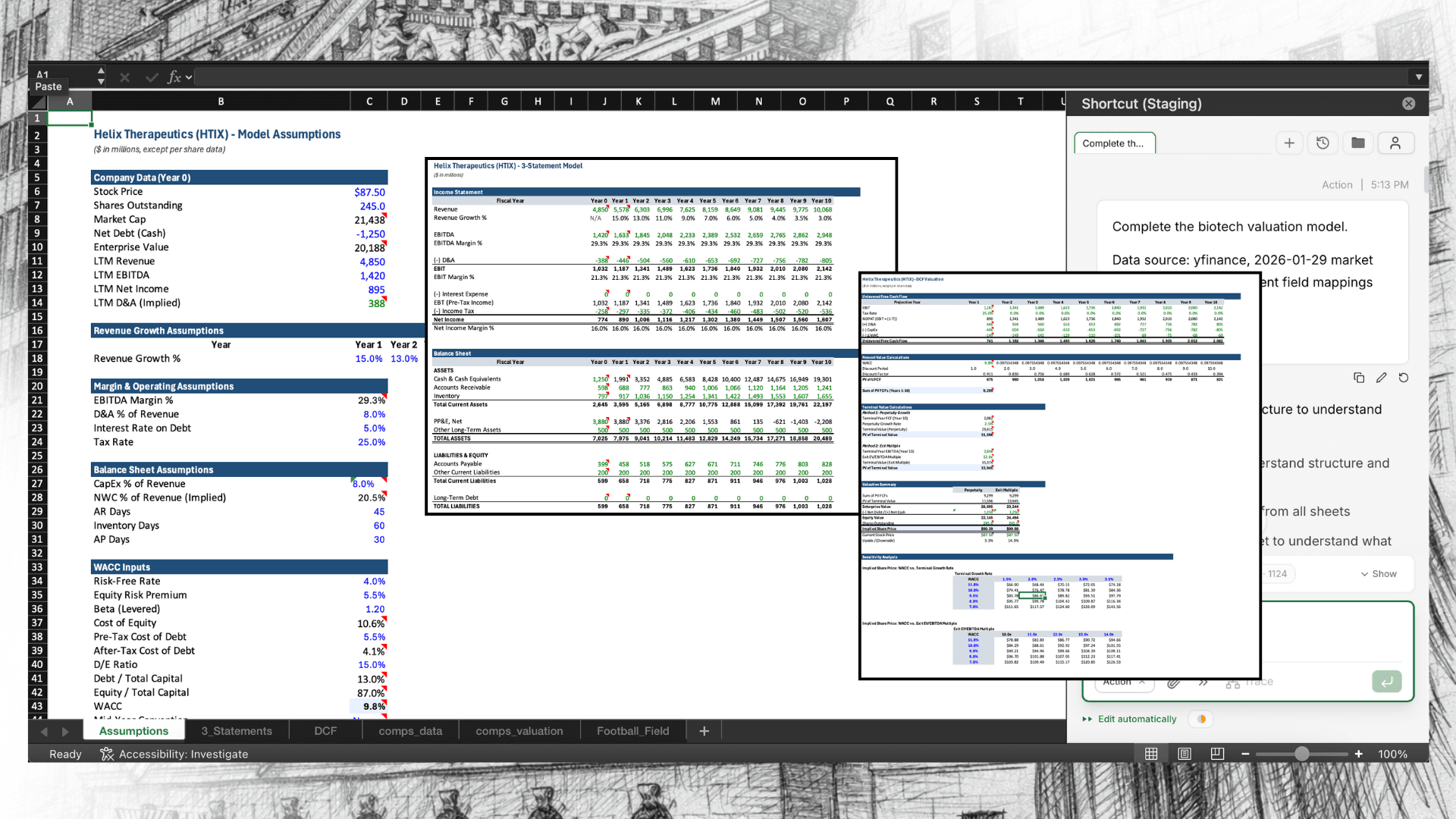
Full valuation model built from template: 500+ formulas across 6 sheets
500+
Formulas Wired
6
Sheets Built
4 hrs → 15 min
Time Saved
- -The Real Problem Isn't Complexity:
- ↳These models are well-understood — any trained analyst knows the mechanics
- ↳The bottleneck is mechanical wiring and quality research for comps, not intellectual difficulty
- ↳Formula linking is tedious but predictable — sourcing and structuring peer data is time-consuming but systematic
- -What Got Built:
- ↳3-statement model — IS → BS → CF with cash as the plug, balance check = 0 for all periods
- ↳DCF valuation — UFCF calculation, perpetuity growth + exit multiple terminal values, PV discounting
- ↳Sensitivity tables — 25-cell matrices recalculating full DCF at each WACC/growth combination
- ↳Comps analysis — 20 biotech peers, tiered by market cap, negative-EBITDA companies excluded from medians. Deep research-quality competitor analysis that takes hours alone, consolidated in minutes.
- ↳Football field — all methodologies consolidated, shows $67-$144 range vs. $87.50 current price
- -What Faster Wiring Unlocks:
- ↳More time to pressure test assumptions — stress test revenue drivers, margin trajectories, terminal values
- ↳More scenarios explored — run bull/bear/base cases, test acquisition premiums, model different capital structures
- ↳More models per company — build multiple valuation approaches instead of stopping at one
The hard part isn't the formulas — it's underwriting the assumptions. Cut out the hours of model plumbing and comps busywork, and analysts can spend their time pressure-testing drivers, framing upside/downside cases, and running multiple valuation builds in parallel.
Quarterly Model Refresh from Vendor Files
Refresh a master quarterly model off third-party vendor workbooks by lining up fiscal quarters despite messy column offsets, remapping P&L line items from inconsistent row structures, flagging hardcodes versus formula logic based on model context and neighboring columns, fixing sign conventions, and rebuilding nuanced and complex EBITDA bridges.
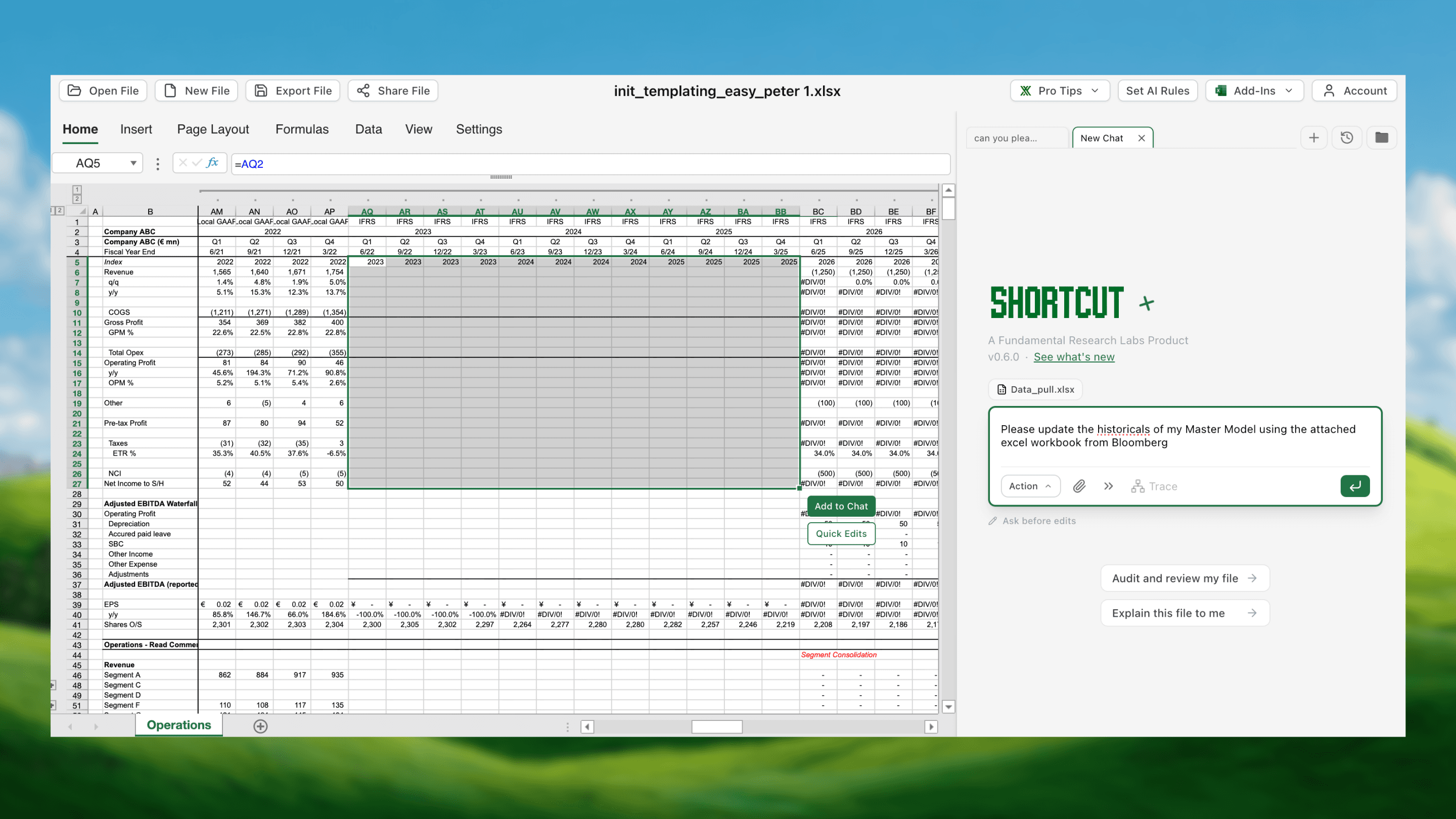
Automated quarterly model population from messy source workbooks
2+
Hours Saved per Model
30+
Models Updated Quarterly
240 hrs
Annual Time Saved
- -The Judgment Calls:
- ↳"Is this the same thing?" — Source "Gross profits" row 8 → Target "Gross Profit" row 11. Same concept, different position.
- ↳"Which way does the sign go?" — Source tax +5,869 but target shows (5,869) in parentheses.
- ↳"Hardcode or formula?" — Row 23 has values in AP, row 24 has =-AP23/AP21. One gets pasted, one gets extended.
- ↳"Did they restructure?" — "Professional Outsourcing" has data through AP, then stops. "Technology" starts at AQ.
- ↳"Does this roll up?" — EBITDA row 37 shows =SUM(BC68:BC76) but waterfall is rows 30-36.
- ↳"Am I off by one quarter?" — Source BP header "2022/6" → Target AQ header "6/22". Same quarter, different format.
- -The Manual Cost:
- ↳2 hours per company per quarter × 30 companies = 240 hours/year
- ↳200+ hours saved per analyst per year
The analyst still validates every number. The difference is whether they spend two hours copy-pasting or ten minutes reviewing. Same rigor, fewer keystrokes.
PDF-to-Excel Quarterly Model Updates
Pull quarterly results out of PDFs \u2014 earnings releases, investor decks, and 10-Qs \u2014 straight into a standardized Excel model. That includes segment detail and waterfall bridges that only exist as images.
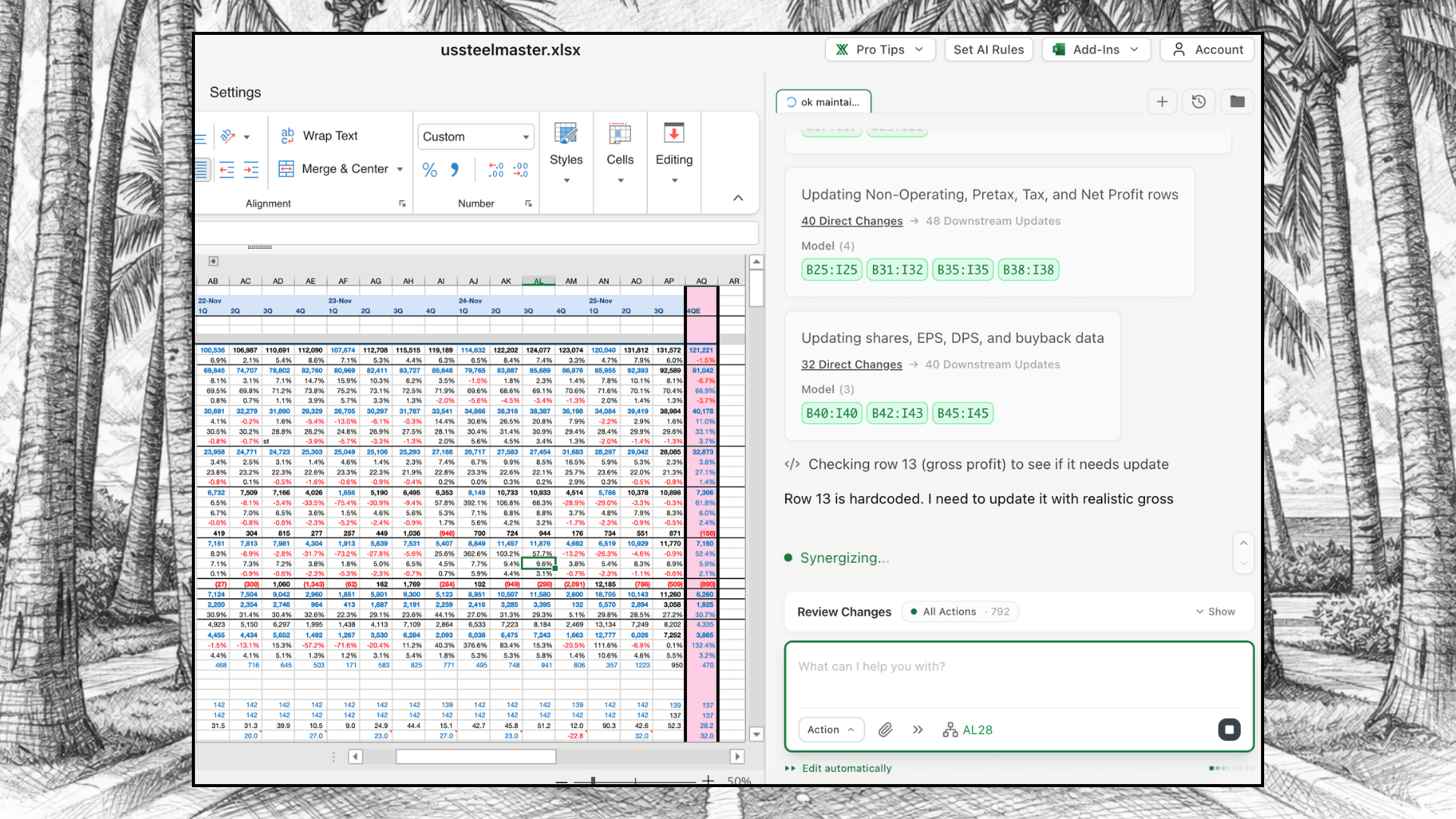
Automated extraction from investor presentations, 10-Q filings, and segment data
3+
PDFs Processed per Update
200+
Data Points Extracted
80 min → 20 min
Time per Company
- -The Task: Update column AQ in a 515-row Driver sheet from 3 separate PDFs
- ↳Parse investor presentation (170 embedded images, 39 pages)
- ↳Cross-reference segment supplement (200+ data points)
- -Why PDF Extraction Fails:
- ↳Embedded images ignored: Most tools extract text only—charts and tables as images are skipped
- -Waterfall charts: Financial data rendered as graphics—standard extraction returns nothing
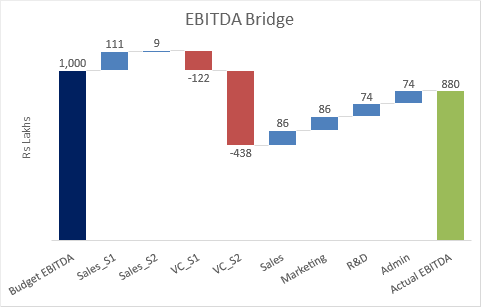
Waterfall charts render financial data as images—standard text extraction fails
- ↳Other tools fail silently: No error, just missing data—analysts don't know what's missing
- -The Earnings Crunch:
- ↳Trading window: 30-60 minutes between release and opportunity
- ↳Manual time: 80 min → 20 min with Shortcut
Most extraction tools skip embedded images entirely. Waterfall charts, segment tables rendered as graphics\u2014they return nothing. With Shortcut, an hour of manual data entry work becomes 10 minutes of verification.